Introduction
Sandbox is a 3D game engine that runs in the browser and publishes to Robinhood Chain. An overview of the studio, the runtime and the platform.
Sandbox is a complete 3D game engine that runs in a browser tab. You import, model or generate your assets, build a world, write the rules, test, then publish. Players are playing within the minute, and the most played builders share the fees of the $SANDBOX token.
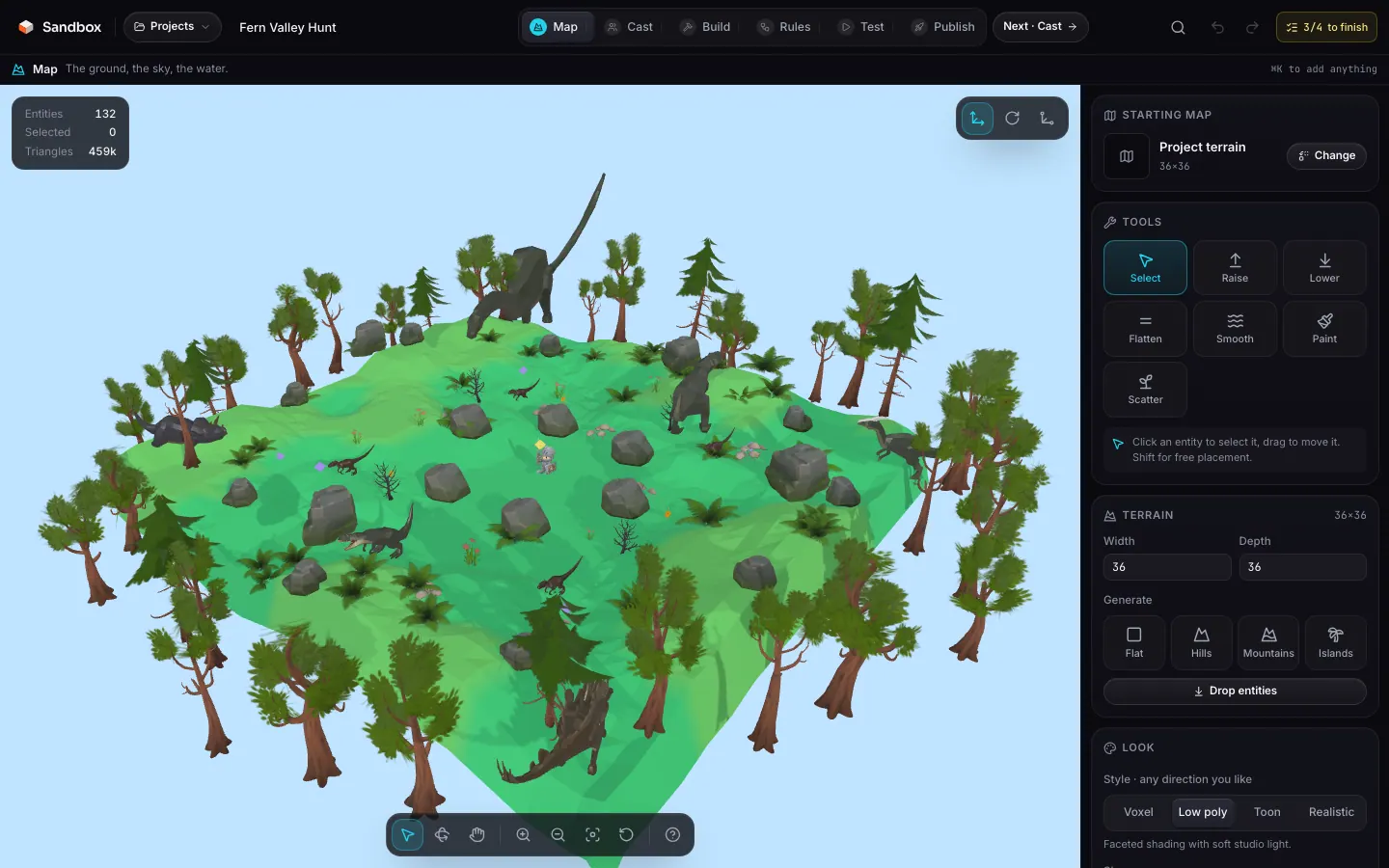
What you can do
Sandbox brings together three things that usually live in separate tools: an editing studio that walks you from terrain to publication in six steps, a game runtime that is identical in the editor and for players, and a platform that publishes, counts plays and pays creators.
Six steps, always the same
The studio is not something you explore: it is something you follow. A project starts from a complete game, a starting map or nothing at all, then the top bar walks you step by step — Map (the ground, the sky, the water), Cast (the player, the enemies, the NPCs), Build (the props and the decoration), Rules (how you win), Test (play it), Publish (put it online). A chip keeps count of the four things still missing before you can publish. The workflow in detail
How it works
Every Sandbox game is one JSON document in the SandboxGame format. It holds the assets, the terrain, the placed entities, the mode and look settings, the variables, the rules and the scripts. The document is canonicalised (sorted keys) then hashed with keccak256: that hash is what gets written to the on-chain registry.
One runtime
The engine running on the studio’s Test step is exactly the one running on the public game page. What you see while editing is what your players get: same three.js rendering, same arcade physics, same rules, same scripts.
Seven game modes
Every document picks a mode that provides the controller, the camera and the win conditions. Switching mode keeps the world: the same terrain and entities become another game.
| Mode | ID | In one sentence |
|---|---|---|
| Race | race | Karts, checkpoints, laps and drift. Bots follow your checkpoint line. |
| Platformer | platformer | Run, jump, collect coins, dodge hazards, reach the finish. |
| Arena | arena | Top-down waves of enemies. Survive, shoot, score. |
| Runner | runner | Endless lanes, obstacles and coins, ever faster. |
| Explore | explore | A world to walk through. Collect what you placed, talk to NPCs, no fail state. |
| Capture the flag | ctf | Two teams, two bases, one flag each. Bring theirs home, keep yours. |
| Tower defense | tower | Waves walk the waypoints toward your base. Build turrets on the way. |
Modes, controls and win conditions in detail
The platform
Publishing stores the document under a path derived from its hash, with its cover, and registers it in the Sandbox.sol contract on Robinhood Chain. Playing a published game needs a connected wallet: every finished run is tied to that wallet and counts fully. Every 24 hours, the vault of creator fees from the token is split between the day’s most played games, in proportion to their weight.
Current status
$SANDBOX publishing threshold and paid AI generation switch on when the token launches.